
Telegram Search Bots—Practical Techniques and Safety Limits
This guide answers one question: how can you find relevant Telegram channels, groups, and files more efficiently while reducing exposure to scams and malicious content?
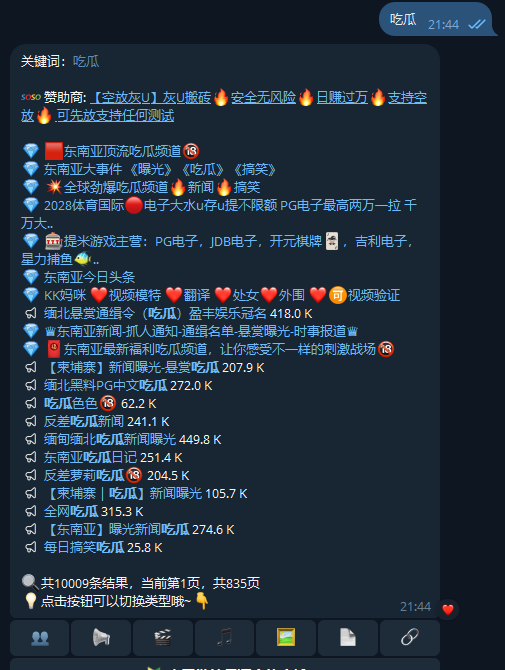
The examples use three third-party bots that were reachable during the source review: @soso, @smss, and @jisou.
Third-party services
These bots are not operated or endorsed by Telegram or this site. Availability, ownership, indexing behavior, data handling, and results can change. Opening a bot link or finding a result is not proof that the service or content is safe.
Preparation
- Confirm that Telegram is reachable on the current network. If it is not, see the proxy-service review guide.
- Install an official Telegram client and sign in. New users can follow the Telegram registration and security guide.
- Define the intended result:
- Channel or group: a source that publishes or discusses a topic over time;
- File: a document or historical archive whose origin can be verified;
- Current event: time-sensitive material that requires corroboration outside Telegram.
- Begin with public descriptions and message history. Do not immediately run an unfamiliar executable, script, macro-enabled document, or archive.
Comparing the example bots
The source author observed the following tendencies. They are not independently measured coverage guarantees:
Soso @soso
Returned a broad result set in the source test and was useful for an initial high-level search.Shenma Search @smss
Appeared more accommodating of mixed-language queries in the source test.JiSou @jisou
Presented channel and group discovery clearly in the tested workflow.
Repeat the same query in at least two indexes. Agreement does not prove authenticity, but it can reveal omissions and ranking differences.



Search techniques
Move from a broad topic to exact identifiers
Start with a broad phrase such as Python tutorial, then narrow it with a version, author, project name, publication, year, file format, or exact error message.
Try language and spelling variants
Search the full name, abbreviation, English spelling, local-language spelling, and common transliteration separately. Indexes may tokenize each form differently.
Evaluate the result before joining
Review:
- account or channel creation and posting history;
- whether updates are regular or suddenly appeared;
- pinned messages and administrator identities;
- links to an independently verifiable official site;
- corrections, source citations, and the ratio of useful content to promotions.
A large subscriber count, a verification-like emoji, or a copied logo is not proof of identity.
Cross-check the entry point
Run the same exact query through @soso, @smss, and @jisou. Then verify an important channel through its owner or organization's official website.
Skip unexplained redirect chains
Treat clickbait titles, unexplained URL shorteners, forced bot chains, and requests to invite contacts before viewing a result as risk signals.
Risk boundaries
Payment and impersonation scams
Avoid private transactions based on promises such as “pay first to enter,” “guaranteed recovery,” or “unlock the complete archive.” Confirm the counterparty and use a payment method with appropriate protections where a legitimate purchase is involved.
Malicious files
Do not run an executable, installer, script, browser extension, macro, or unknown archive merely because it appeared in several search results. Obtain software from the publisher's official release channel, verify its signature or checksum when provided, and use an isolated analysis environment only if you understand the residual risk.
Copyright and legal risk
Search results can link to unauthorized copies or unlawful material. Follow the laws that apply to you and the platform's terms. Do not redistribute material without the required rights.
Privacy
A bot receives the messages and commands sent to it and may send data to its operator's infrastructure. Do not enter telephone numbers, email addresses, passwords, login codes, payment details, private documents, or confidential search terms.
Frequently asked questions
How is a search bot different from Telegram's global search?
Telegram's own search is useful for public usernames and accessible content known to its index. A third-party bot may aggregate a different set of public links and messages. Its broader-looking results also have less predictable quality and data handling.
Why do bots return different results for the same query?
They can crawl different sources, update on different schedules, tokenize languages differently, remove content under different rules, and rank results with separate algorithms.
Should I download a file directly from a result?
No. First verify the publisher, message history, file origin, signature or checksum, and whether an official distribution exists. Treat executable content as high-risk by default.
Can a bot read my private chats?
A normal bot receives its direct conversation with you and data explicitly sent or made available to it under Telegram's bot and group rules. It does not thereby gain unrestricted access to every private conversation. Still, minimize the sensitive information sent to any third-party bot.
How do I decide whether to follow a source?
Look for stable publishing history, primary-source links, transparent corrections, identifiable ownership, and a low proportion of deceptive advertising. Recheck important claims outside Telegram.
Summary
Search bots can reduce discovery time, but they also introduce an unverified intermediary. Define the target, vary the query, compare more than one index, verify the source outside the bot, and inspect before downloading. The three examples—@soso, @smss, and @jisou—are starting points, not trust endorsements.