
AI Can Spend Money for You Now. How Far Away Is an AI-Run Company? What Cloudflare Wallet Is and How to Reserve One
Cloudflare recently announced something rather interesting: Cloudflare Wallet.
My first thought was not, “Cloudflare is launching another crypto wallet.” It was: AI is finally getting a wallet of its own.
AI can already write code, research information, and call APIs. But as soon as a task requires registration, a payment card, account funding, or an API key, a person must take over. Cloudflare Wallet aims to give AI the two missing pieces: identity and payment capabilities.
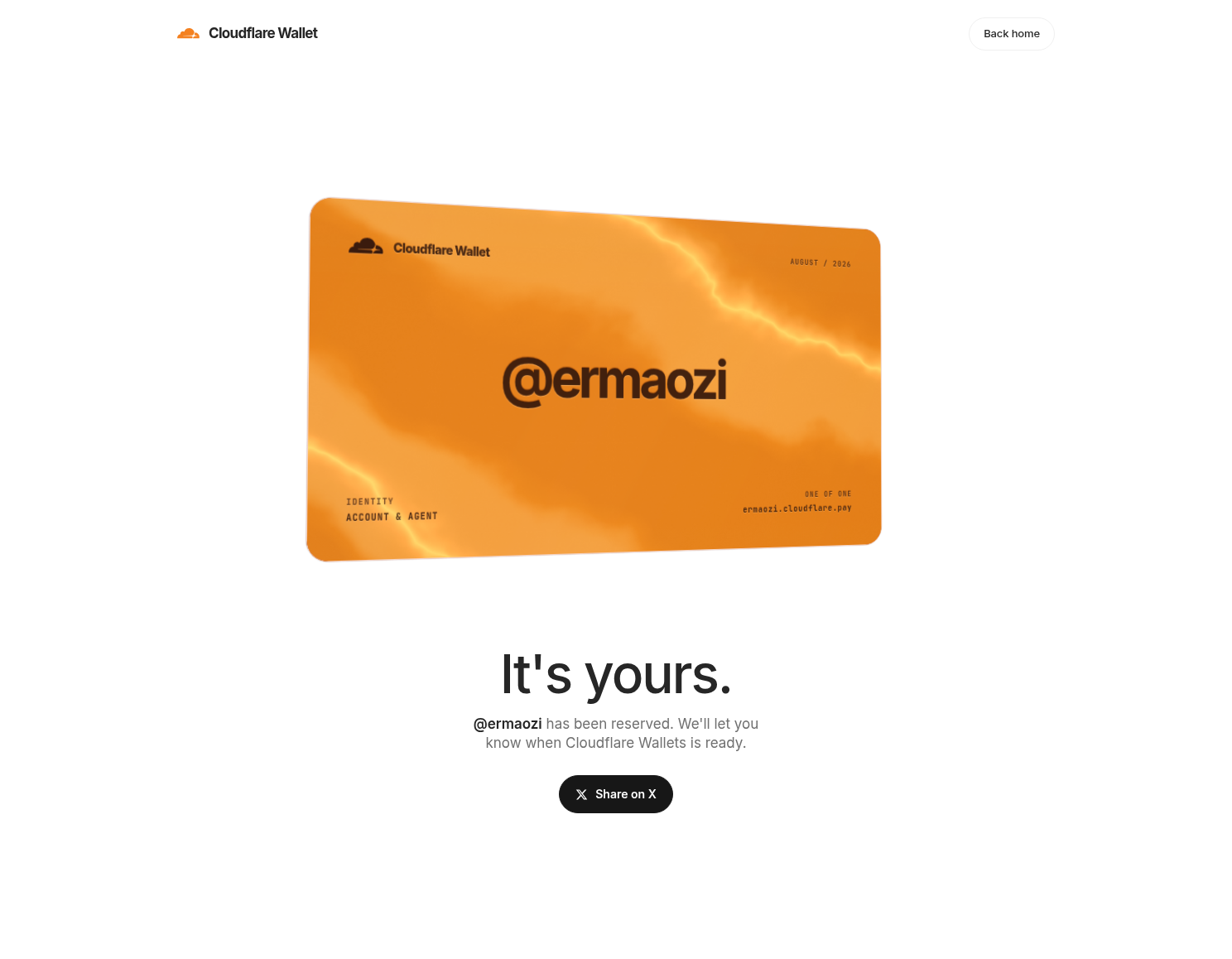
I have already reserved @ermaozi:
Current status first
As of August 6, 2026, Cloudflare Wallet has not officially launched. You can reserve a unique name, but you cannot yet add funds, create a Virtual Wallet, or let an AI make a real payment.
Cloudflare says it is coming Soon, without announcing a launch date, fees, or supported regions. For now, an “application guide” is more accurately a name-reservation guide.
What is Cloudflare Wallet?
In simple terms, Cloudflare Wallet is a programmable wallet and optional identity system designed for AI agents.
It is not a bank card for people to swipe, nor is it simply another app for trading crypto. Cloudflare's idea is that a person deposits money and defines rules in an account wallet, then allocates a limited amount to an AI so it can buy APIs, MCP tools, data, or paid content on its own.
Cloudflare plans two wallet types:
| Type | Who controls it | Purpose |
|---|---|---|
| Account Wallet | The Cloudflare account owner | Add or withdraw funds, allocate money to AI agents, and define rules |
| Virtual Wallet | An AI agent using an API key | Pay automatically within its balance, allowlist, and per-transaction limit |
The point is not to let AI spend without restraint. It is to replace a person's approval of every transaction with financial boundaries defined in advance.
What is x402, and how does it relate to Cloudflare Wallet?

Cloudflare Wallet is not being built in isolation. It will use the x402 protocol to pay websites and APIs.
402 Payment Required is the HTTP status code for a resource that requires payment. x402 turns pricing, payment, and access into one machine-readable HTTP flow.
A conventional API trial often looks like this:
Find the website → create an account → verify an email address → add a payment method → fund the account → create an API key → call the API
The x402 flow envisioned by Cloudflare is closer to this:
AI requests a service → the service returns a price → the Virtual Wallet pays under its rules → the AI receives the API result or paid content
For API calls that cost only a few cents, this makes much more sense than opening and funding a separate account for every provider. Cloudflare's Monetization Gateway is intended to help eligible sellers receive payments, while Wallet is intended to help buyers and AI agents pay.
What can you do with Cloudflare Wallet now?
There are only two practical uses today:
- Reserve a name early: like a domain or username, desirable names will probably become harder to obtain.
- Claim a public identity placeholder: after a successful reservation, an address such as
ermaozi.cloudflare.payredirects to the corresponding public Wallet page.
It cannot currently do any of the following:
- accept stablecoin deposits;
- withdraw funds;
- create a Virtual Wallet;
- generate a payment API key for an AI agent;
- set weekly budgets, allowlists, or per-transaction limits; or
- pay a real x402 endpoint with Cloudflare Wallet.
Do not send funds to any blockchain address that claims to be a “Cloudflare Wallet deposit address.” The official name-reservation flow does not ask for a seed phrase, private key, or deposit.
How to reserve a Cloudflare Wallet name
What you need
You only need:
- a Cloudflare account you can sign in to;
- an unreserved Wallet name; and
- the official
cloudflare.payanddash.cloudflare.comdomains.
The current page applies these name rules:
- between 3 and 32 characters;
- lowercase English letters, numbers, and hyphens (
-) only; - do not include
@; and - one reservation per Cloudflare account.
Cloudflare has not announced a name-change process, so do not reserve a disposable test name that you would not want to keep. The reservation page also says Cloudflare may reject a name for any reason.
Step 1: open the Cloudflare Wallet website
Visit https://cloudflare.pay/.
The page should display Reserve your Cloudflare Wallet and an orange Wallet card.
Step 2: enter your preferred name
Enter a name such as ermaozi. The page checks its availability automatically:
- a green check and available means it can be reserved;
- already reserved or taken means you need another name; and
- a length or character error means the name must be adjusted to meet the rules above.
Step 3: reserve the name
When the name is available, click Reserve @your-name.
Your browser should redirect to a Cloudflare authorization page on dash.cloudflare.com. Sign in to your Cloudflare account, confirm that the domain is correct, and follow the on-screen instructions.
Step 4: confirm the reservation
After authorization, the page should display It's yours. followed by:
@your-namehas been reserved. We'll let you know when Cloudflare Wallets is ready.
Only then has the name been successfully reserved. Save the confirmation page and wait for Cloudflare's launch notification.
If the page displays Already reserved, the current Cloudflare account has already reserved a name and cannot reserve a second one.
How might Cloudflare Wallet work after launch?

The following is the target flow described in Cloudflare's announcement. It is not a product walkthrough that you can complete today:
- A user adds funds to an Account Wallet. Cloudflare plans to support stablecoins and ways to move money in and out in supported regions.
- The user creates a Virtual Wallet for an AI agent.
- The user defines a total allowance, a per-transaction limit, and an allowlist of merchants or APIs.
- The AI uses the Virtual Wallet's API key to buy access to x402-compatible APIs, MCP tools, data, or content.
- When a purchase exceeds its limits, the AI stops and asks an authorized person for a one-time approval or a higher limit.
If you are already building an AI agent, you can read Cloudflare's published x402 documentation. Until Wallet launches, however, there is no reason to hard-code assumptions about deposits, fees, or supported regions.
What could Cloudflare Wallet change?
1. AI could choose APIs instead of using only services selected in advance
An AI could spend a few cents testing dozens of translation, search, or inference APIs, then choose the best option for the current task based on price and output quality.
API competition could gradually shift from “which company markets itself best” to “which provider offers the best price and result for this particular request.”
2. Websites might rely on more than subscriptions and advertising
The unit of sale could be one API call, one data record, one article, or one expensive computation. A customer would not need a monthly subscription for a single use, while the seller could recover costs through micropayments.
3. AI could gain a persistent, recognizable identity
For example, research.example.cloudflare.pay could identify a research agent run by a particular organization. A merchant could recognize the account behind the AI and decide whether to offer trial credit, prioritize its requests, or limit access.
Cloudflare says identity disclosure will be optional. It is better understood as a memorable name attached to a machine credential, not a requirement for every AI to reveal its real owner.
4. Companies could give AI a budget without approving every payment
A company might give each employee's AI a $100 weekly inference budget, or give a research agent $10 to compare data sources. The AI could continue working while spending remains within the rules, with a person stepping in only when unusual spending occurs.
That is more sensible than handing an AI the private key to a primary wallet, but it does not eliminate risk. Prompt injection, malicious APIs, incorrect prices, leaked credentials, and stablecoin compliance will all become new concerns.
AI can spend money for you now. How far away is an AI-run company?
My view is that it is not far away operationally, but still far away legally.
An AI that can select APIs, pay service fees, acquire data, generate a product, support customers, and buy advertising already resembles the operating system of a one-person company. Cloudflare Wallet adds an important missing capability: controlled spending.
Actually forming and running a company also involves its jurisdiction, beneficial owners, identity verification and KYC, signature authority, taxation, employment, refunds, and accountability when something goes wrong. A wallet cannot solve all of that.
A more accurate conclusion is:
Cloudflare Wallet will not instantly turn AI into a company owner, but it could move AI from “recommending what you should buy” to “buying it directly within the budget you defined.”
I expect more small companies to appear in which one person sets the goals and several AI agents handle operations. The person's most important job will not be clicking every button. It will be defining objectives and boundaries, then taking responsibility when the AI makes a mistake.
Cloudflare Wallet FAQ
Can I add funds to Cloudflare Wallet now?
No. As of August 6, 2026, Cloudflare has opened only name reservations. There is no Wallet funding interface yet.
Does it cost anything to reserve a Cloudflare Wallet?
The current name-reservation page has no payment step. Cloudflare has not announced Wallet fees, blockchain transaction costs, or charges for moving money in and out.
Will users in China be able to use it?
Cloudflare says only that ways to move funds in and out will be available in “supported regions.” It has not published a complete country and region list. The ability to reserve a name does not guarantee that funding, KYC, or withdrawals will be available later.
Is Cloudflare Wallet self-custodial?
Cloudflare's announcement does not describe the final private-key custody model. The product is intended to store stablecoins and make and receive payments, but you should not assume it will provide a seed phrase or be fully self-custodial until Cloudflare publishes the details.
Could an AI spend the entire balance at once?
Cloudflare plans to limit Virtual Wallets through available balances, merchant allowlists, and per-transaction caps. These controls can reduce the maximum loss, but they do not replace API-key protection, anomaly monitoring, or human review.
Official resources
- Cloudflare's Cloudflare Wallet announcement
- Cloudflare Wallet name-reservation page
- x402 payments for Cloudflare Agents
- x402 protocol website
I have reserved the name. The next step is to wait for Cloudflare to launch the actual Wallet. When it does, I will test funding, Virtual Wallets, budget controls, and x402 payments with a real account instead of guessing from a product announcement.