
Stripe Agrees to Buy OpenRouter as Google Bids for Airline Data: AI Control, Apple Alerts, and Device Security
From August 14 through August 20, 2026, the important AI question was not another benchmark score. It was who controls the gateway, the data, and the safety signal. Stripe agreed to acquire OpenRouter, Google became the top bidder for de-identified records from a bankrupt airline, and OpenAI previewed a way to detect risks across interactions while preserving Zero Data Retention. Meanwhile, Apple made mercenary-spyware alerts more visible, and two very different software and device stories showed why installing an update is the beginning of incident response, not the end.
Draft disclosure: Ermao Blog prepared this draft with public-source research and automated assistance. It is awaiting human review. Official statements, court records, independent reporting, research observations, and this site's analysis are labeled separately. “Confirmed” means only that the cited evidence supports the stated fact; it does not imply testing by this site.
What matters this week
| Lane | Event | Verified fact | Why it matters | Evidence status |
|---|---|---|---|---|
| AI infrastructure | Stripe agrees to acquire OpenRouter | OpenRouter says it routes among 400+ models from 80+ providers; the transaction is not yet complete | A payments company is entering the model-routing layer, where billing, ranking, and data flows meet | Company statements plus independent reporting; verified |
| AI and enterprise data | Google bids $10 million for Spirit Airlines data | A court filing identifies Google as the top bidder; court approval was still pending | Corporate email, chat, and documents have been priced as an AI asset | Court record plus independent reporting; verified |
| AI privacy | OpenAI previews Private Safety Processing | ZDR content can remain on customer infrastructure or be encrypted with customer-controlled keys, while OpenAI receives limited risk signals | Content retention and cross-interaction abuse detection are no longer presented as a simple either-or choice | Official preview; verified, not independently audited |
| Account and device security | Apple adds lock-screen threat alerts | Apple confirmed notifications across 110 countries and regions but did not disclose the operators or full country list | High-risk users gain a faster verification path; phishers gain a new theme to imitate | Apple guidance plus independent reporting; verified |
| IoT security | Researchers observe 14,500+ compromised Dahua devices | The investigation connects password attacks, old authentication bypasses, and P2P exposure | A device behind NAT is not necessarily undiscoverable or unreachable | Primary research plus independent reporting; verified |
| Cross-border tools | v2rayN 7.24.7 ships an urgent security fix | The project warns of a man-in-the-middle risk in the old downloader but gives no affected-version floor or exploitation evidence | Updating protects future downloads; it does not validate old files | Official release; verified |
| Telecom industry | Nokia reportedly plans a major China retrenchment | Two outlets report closures of most mainland sites and large staff reductions; Nokia has not published a complete list | The change may affect jobs, R&D, delivery, and suppliers, but does not prove an imminent network outage | Two independent reports; candidate |
| Medical science | Personalized mRNA melanoma vaccine reports positive top-line Phase 3 results | The companies reported positive endpoints in a trial of more than 1,100 patients; full data remain unavailable | It is a significant late-stage milestone, not an approval or evidence for every cancer | Independent report of company disclosure; candidate |
Seven of the eight main stories fall within Ermao Blog's core coverage of AI, digital services, security, telecom, and cross-border tools. The melanoma trial is the single broader public-interest story. All seven daily records are now marked complete. The August 19 collection did not run on schedule because of a usage limit, so this weekly pass backfilled only that date instead of rediscovering the entire week. The mandatory second look also replaced a narrower chipset exploit and a second environmental-science item with the more direct Dahua and Nokia stories.
OpenRouter's gateway is being acquired
On August 20 in Shanghai time, Stripe confirmed that it had agreed to acquire OpenRouter. Neither party disclosed a price, and neither described the transaction as closed. Their public description says OpenRouter can route requests across more than 400 models from over 80 providers, choosing among them by task, price, speed, and reliability.
The first question is neutrality. OpenRouter can rank or select models by cost and performance today. After the deal, will default routing be influenced by commercial agreements, Stripe payment relationships, or other incentives? Access to “400+ models” does not mean equal visibility for every provider. Useful transparency would identify the candidate models, selection reason, fallback path, and final bill, rather than returning only a uniform answer.
The second question is data handling. A routing layer must at least process the destination, model identifier, usage, latency, and errors. Depending on configuration, it may also handle prompts and outputs. The acquisition statement does not say whether logging, training use, subprocessors, regional processing, or deletion rules will change. Users do not need to assume misuse, but teams handling code or confidential records should preserve the current policy and compare it with whatever replaces it after closing.
The third question is exit cost. A common API can conceal model differences without eliminating them. Tool calls, context caching, reasoning objects, safety behavior, and prompt formats can remain provider-specific. If a team embeds retries, billing, model identifiers, and proprietary routing fields throughout its application, it may still be difficult to leave when price or policy changes. Keeping provider-level usage records and a tested direct-provider path is a small, practical hedge.
The confirmed fact is an agreement to acquire. The rumored price, closing date, future ranking rules, and policy changes remain unconfirmed. Most individual users do not need to act immediately. Developers using multi-model APIs should record a baseline now and recheck it after the transaction closes.
Spirit Airlines data auction: de-identification is not a universal waiver
The Spirit Airlines proceeding gives corporate AI data an explicit price. A U.S. bankruptcy court notice of auction results identifies Google as the top bidder for de-identified data at $10 million and schedules a later hearing. The accurate description is “top bidder awaiting approval,” not “Google has received and trained on all the data.”
Reports describe the assets as including corporate email, chat, documents, and other collaboration records. Their value is not merely the number of words. Long-running internal archives contain process, exception handling, decision order, job-specific language, and relationships among teams. Those structures could improve retrieval, office assistants, enterprise knowledge tools, or more general models. Treating the archive as a separately priced asset also shows that a company's digital record can remain valuable after operations fail.
De-identification removes some direct identifiers; it does not eliminate every privacy risk. Names, addresses, employee numbers, and accounts can be removed or replaced, while rare events, job titles, times, routes, project codes, and contextual combinations can still point back to a person or team. The strength of the process depends on what is delivered, which methods are used, what external data can be linked, and whether the buyer is prohibited from re-identification. A sale condition is not the same as an independent privacy audit.
Purpose change matters too. Employees and partners supplied information to operate an airline, not necessarily to create a model-training asset after bankruptcy. A legally permitted asset transfer, a contractual data clause, and the reasonable expectations of the people in the records may not align. That does not prove the transaction is unlawful. It does mean the word “de-identified” should not end the ethical analysis.
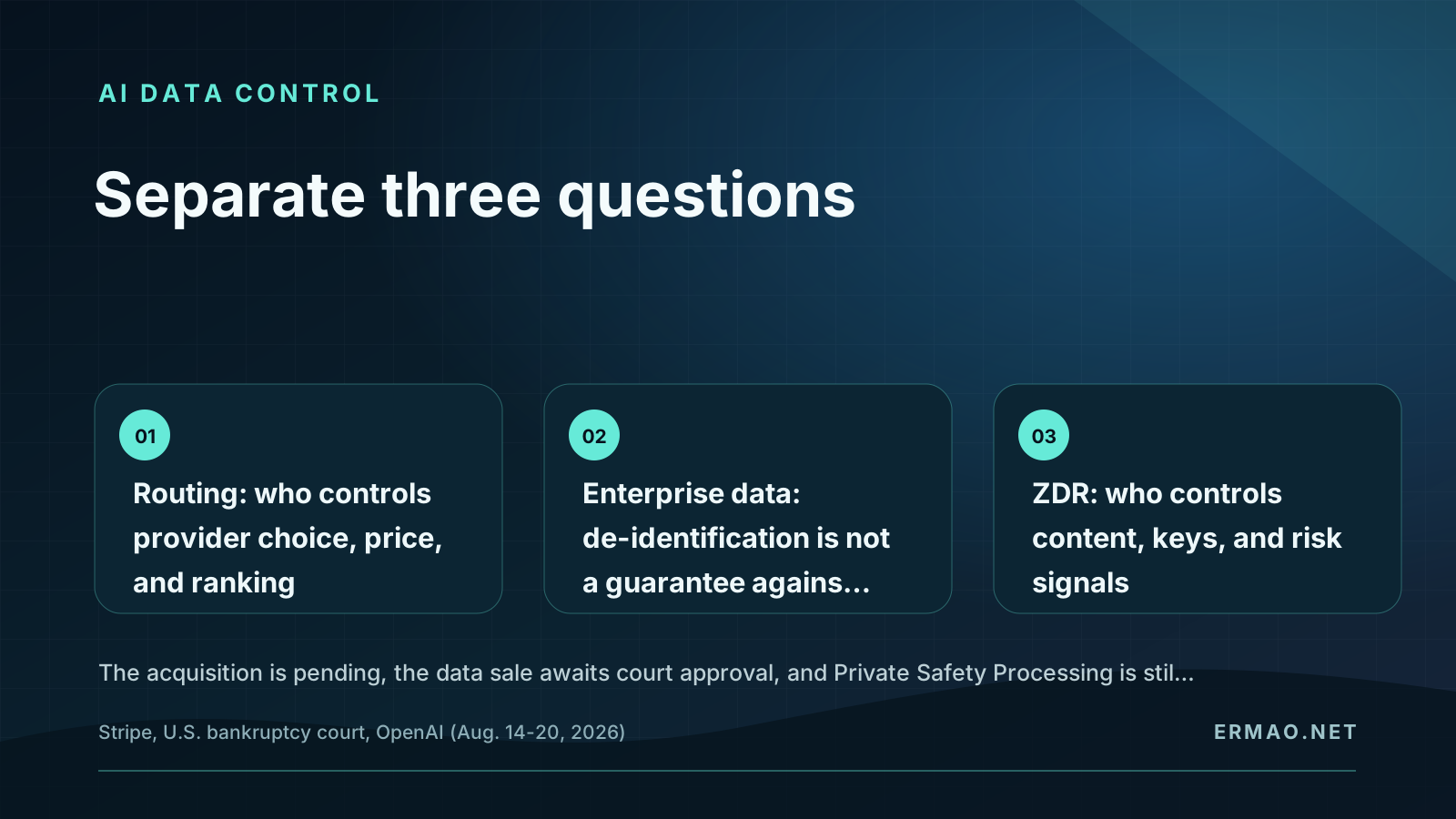
For organizations, the durable lesson is an exit checklist. On a sale, merger, liquidation, or SaaS migration, who owns email, tickets, meeting notes, transcripts, and chats? May the archive be sold separately? Are employees and customers notified? Who validates de-identification? May a buyer train, resell, or reconnect the records? Can deletion requests still be honored? If the first serious discussion happens at a bankruptcy auction, the governance decision is already late.
This reporting confirms only Google's stated intent to improve products and AI models. It does not identify a model, training date, final delivery volume, or completed privacy review. The next meaningful evidence will be the court's approval decision and any enforceable conditions or auditable governance details.
OpenAI's ZDR preview: detecting a sequence without retaining the conversation
On August 19, OpenAI announced a preview of Private Safety Processing. The company first restated its promise for eligible Zero Data Retention customers: prompts and responses are not retained by OpenAI after a request is processed, personnel cannot review that customer content, and enterprise content is not used for training unless the customer explicitly opts in.
The new system addresses a different problem. A harmful intention may become visible only across several requests, while a per-request safety check sees fragments. OpenAI describes one design in which content remains on customer-controlled infrastructure. It is also developing an OpenAI-hosted option where content is encrypted with customer-controlled keys that OpenAI personnel do not possess. Automated processing can identify a pattern, while the provider receives a narrowly defined risk signal rather than the underlying prompts and responses.
This design separates three kinds of control. The customer controls content and keys. Automated processing sees enough data to classify a sequence. OpenAI receives a limited signal and may enforce policy. That is more precise than saying either “the provider sees nothing” or “safety requires full conversation retention,” but it creates audit questions: Where does processing run? How long a sequence is visible? How are interactions linked? What metadata is in a signal? How is a false positive corrected? What happens when a key is rotated or lost?
ZDR also has an explicit exception. OpenAI says images flagged as possible child sexual abuse material continue to be retained for manual review and legally required reporting. The exception does not erase the broader commitment, but it prevents a customer from treating “zero retention” as an unconditional statement covering every data type, jurisdiction, and circumstance.
Private Safety Processing is still being tested with early customers, with a technical white paper and initial rollout planned for September. We can confirm the architecture OpenAI says it is pursuing. We cannot yet confirm its isolation, cryptographic implementation, error rates, performance cost, or independent audit results. Customer endorsements on the announcement page are opinions, not security assessments.
A buyer's minimum checklist should identify the exact endpoints and models eligible for ZDR; storage in the customer's gateway, observability stack, and provider systems; key creation and revocation; caching and tool-call exceptions; the relationship between a risk signal and account enforcement; and an appeal process that does not require unnecessary disclosure. Ermao Blog's editorial policy explains why a provider's architecture statement is labeled as a provider claim until outside evidence can test it.
Apple lock-screen alerts: verify the channel before diagnosing the phone
Apple's latest threat-notification round covered 110 countries and regions and added a lock-screen route. Apple reserves these warnings for rare, sophisticated, highly targeted mercenary-spyware activity, often directed at people because of their profession or public role. This is not an ordinary antivirus pop-up or a security promotion sent to everyone.
Visibility can shorten the time before a high-risk person reacts. It also gives phishers a recognizable theme. A genuine Apple threat notification does not ask a recipient to follow a link in the message, install a cleanup utility or configuration profile, pay a fee, or provide a verification code. The safest first step is to open the Apple Account area in Settings or manually navigate to the official account site.
A verified notification still does not publicly prove complete device compromise. Apple's alert is a high-confidence risk signal, but the company did not disclose the operators, exploit chain, full country list, or forensic status of every phone. Recipients should treat it as an urgent escalation without announcing attribution that the evidence does not support.
A measured response is to preserve the alert time and device details, verify through Settings or the official site, update iOS and applications, consider Lockdown Mode, avoid sensitive work on a potentially affected device, and contact a trusted security organization. For journalists, human-rights workers, attorneys, researchers, political figures, and other high-risk people, professional assistance can be more valuable than assuming a factory reset resolves every issue.
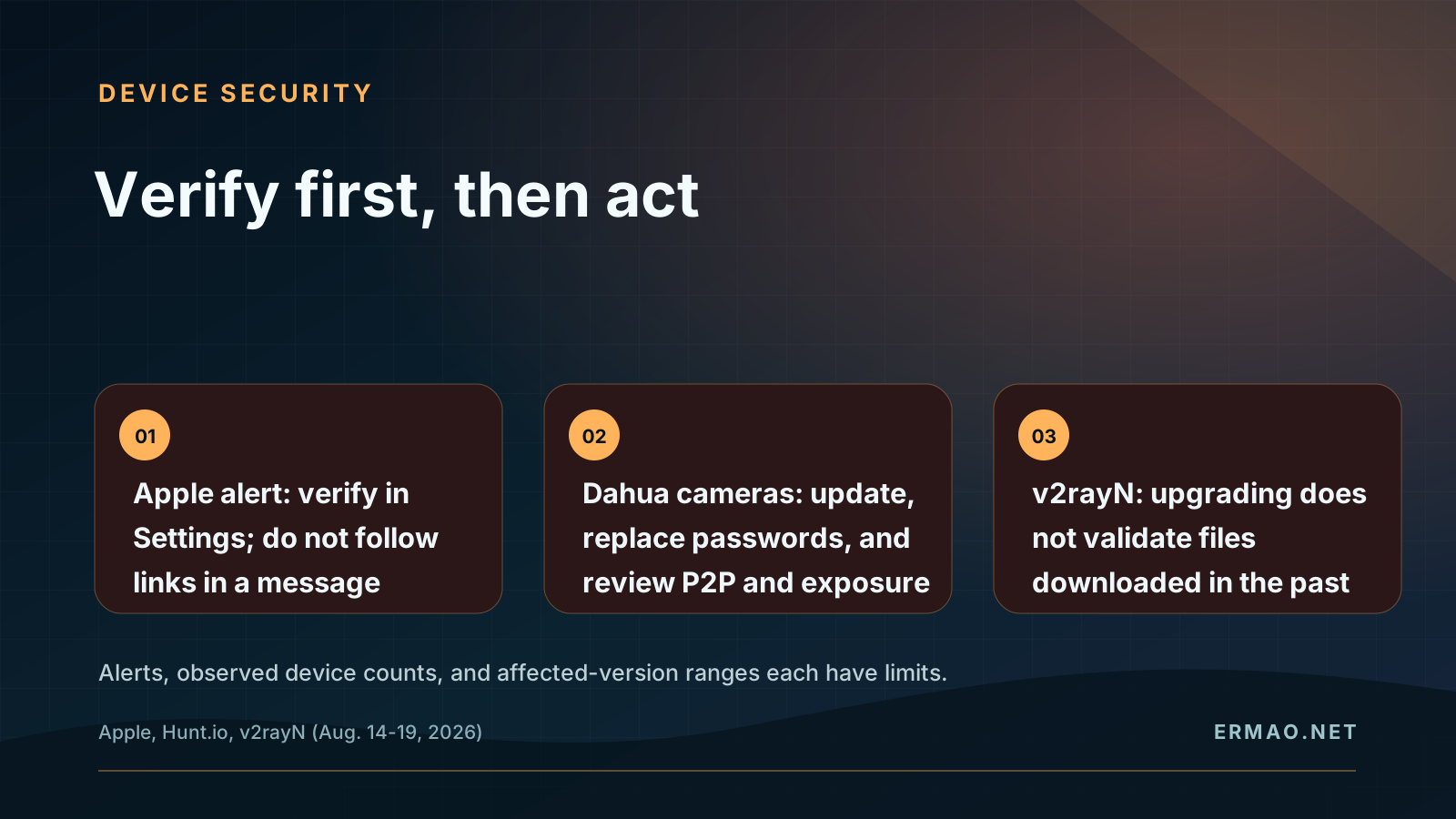
Not receiving a notification is not a guarantee of safety. This channel targets a narrow class of advanced operations, not ordinary phishing, account theft, or every form of malware. Everyone still benefits from current software, unique passwords, multi-factor authentication, and minimal permissions. High-risk users need additional separation of sensitive accounts, reduced attack surface, and a response contact chosen in advance.
The supported facts are the notification scope and Apple's response guidance. The unsupported extremes would be “Apple proved that a named actor fully compromised every recipient” and “this is just another scam pop-up.” The correct position is between them: a high-confidence signal that demands verification, while attribution and device state require more evidence.
14,500 Dahua devices: NAT is not an invisibility cloak
Hunt.io's Operation CameraSwarm investigation observed more than 14,500 compromised Dahua devices. It connects automated credential attacks, known authentication bypasses, and discovery through the vendor's peer-to-peer access mechanisms. Independent reporting on August 19 brought the findings into the weekly window.
The number is an observation during a research period, not a permanent worldwide count. It does not prove that every device remains online, serves the same purpose, or belongs to one operator. The public record is also insufficient to attribute the operation or describe what happened after compromise on every camera. Scale is evidence of a material problem; it is not a substitute for per-device forensics.
The counterintuitive point is reachability. NAT can block unsolicited inbound scanning, but a camera that initiates a connection to a vendor cloud, P2P coordinator, or relay already has an external communication path. Add default or reused credentials, old firmware, and an authentication bypass, and “it is behind my router” protects against only one possible route.
Households and small businesses can act without a forensic lab. Record the exact model and hardware revision, verify firmware through the vendor, replace default and reused passwords, disable unnecessary P2P, cloud access, UPnP, and remote administration, isolate cameras from general devices, restrict outbound destinations, and review account and network logs. Replacement may be safer than layers of compensating controls when a device is no longer supported.
Organizations also need ownership. Cameras may be procured separately by facilities staff, contractors, retail sites, schools, or business units. Without a list of model, serial number, location, owner, firmware, cloud account, and network policy, a security team cannot map an advisory to real assets. IoT risk often persists because responsibility is fragmented, not because nobody has seen the CVE score.
The cited old vulnerabilities do not imply that every Dahua product has the same flaw. Vendor advisories, research samples, and reported models need to be mapped carefully. Brand-wide panic is unsupported; ignoring password and P2P risk because one model is absent from a sample is equally weak. The useful evergreen follow-up is a camera-exposure and P2P audit checklist.
For readers centralizing network rules, the router-level routing and firmware guide explains segmentation, firmware, and failure boundaries. It is not a camera audit and does not replace vendor updates. The relevant principle is to place IoT devices on a network that can be observed and restricted, not to assume a VPN makes every downstream device safe.
v2rayN: an update secures future downloads, not historical files
v2rayN released version 7.24.7 on August 15 and labeled a man-in-the-middle risk in the old built-in downloader as urgent. The release also added Happy Eyeballs, custom fake-IP behavior, Hysteria2 ECH, and other features, but the security notice deserves priority. The project did not provide a CVE, an affected-version floor, or evidence of exploitation in the release notes.
The downloader is part of a trust chain. A proxy client may fetch cores, rule sets, geography databases, and other components. If an old update path permitted substitution, a user might receive an untrusted file without an obvious application error. Updating changes how future downloads work. It cannot go backward and authenticate every binary already saved, executed, or configured to start automatically.
Response therefore has two tracks. For the future, install the fixed release from the official project page, check hashes or signatures when available, and avoid unofficial bundles. For the past, review old download directories, component sources, and timestamps, then reacquire important binaries from trusted sources. Files obtained over an untrusted network deserve more scrutiny when they lack a verifiable signature.
Credential rotation depends on the path, not on a slogan. If a questionable binary ran and could read subscriptions, configuration files, environment variables, browser traffic, or panel tokens, those credentials require assessment. A failed download that was never executed has a different boundary. Because the project did not report exploitation, this article does not claim that old-version users were compromised.
Cross-border clients bundle a user interface, proxy cores, rules, databases, and an updater; updating the main window may not update the active core. Check components individually. The Windows and macOS access guide provides general context, but official project releases remain the source for binaries. The durable sequence is notice, update, provenance check, historical-file review, and credential rotation only when the exposure path supports it.
Nokia's reported China retrenchment: industrial change is not an instant outage
On August 19, the South China Morning Post and Lianhe Zaobao reported that Nokia planned to close most mainland China sites by year-end, reduce most staff, and retain mainly after-sales service. Reports also described an N+3 compensation arrangement attributed to former employees. Nokia did not publish a complete site, headcount, or schedule list during this review, so the story remains labeled “reported” and candidate.
This is more than a routine layoff item because Nokia's China presence has included R&D, sales, service, global delivery, and supply. A site closure can affect local adaptation, customer engineering, procurement, product work, and suppliers at the same time. A multi-site reduction would represent organizational restructuring in China's telecom-equipment market, not merely a quarterly headcount cut.
It does not prove that mobile service will fail immediately. Deployed network equipment, maintenance contracts, spares, software support, and retained service teams do not disappear when an office closes. The reports specifically say after-sales service will remain. Customer impact depends on product lines, contracts, delivery arrangements, and regulatory requirements that have not been disclosed.
The employment numbers require the same caution. A regional headcount in an annual report is context, not the number affected by this plan. “Most staff” and “most sites” remain qualitative until a company list exists. An N+3 account from former employees should not be generalized to every legal entity, location, contract, or worker.
The next evidence should come from Nokia statements and filings, changes to local entities and facilities, operator procurement and maintenance contracts, supplier behavior, and sustained hiring patterns. One report can establish a direction. A sequence of records is necessary to measure effects on R&D, delivery, and market position.
Readers should separate three timescales. Site and staffing changes can occur in months. R&D and supply-chain effects may become visible over quarters. Replacing deployed telecom networks often takes years. Mixing those horizons turns a real but gradual industrial shift into a same-day disaster—or dismisses a long-term change because phones still work this morning.
Weekly interest radar: a positive Phase 3 mRNA result is not availability
Moderna and Merck reported positive top-line Phase 3 results for a personalized mRNA cancer vaccine used with Keytruda in high-risk melanoma after surgery. CNBC's August 19 report describes more than 1,100 participants and says the combination prolonged recurrence-free survival and reduced the risk of distant metastasis relative to Keytruda alone.
This is a meaningful late-stage milestone. It moves a personalized mRNA vaccine beyond a small early study into larger confirmatory testing. “Positive key endpoints,” however, does not answer every clinical question. Full data were not available in this review, including absolute risk differences, complete adverse-event results, follow-up length, subgroup performance, and statistical detail. A relative improvement without baseline outcomes is hard for a patient to interpret.
A personalized vaccine is not one fixed formulation for everyone. The process generally involves analyzing a patient's tumor, choosing neoantigens, manufacturing a corresponding product, and combining it with existing immunotherapy. Production time, cost, quality control, hospital workflow, eligibility, and reimbursement all affect access. A result in adjuvant treatment for high-risk melanoma cannot be generalized to every cancer, stage, or drug combination.
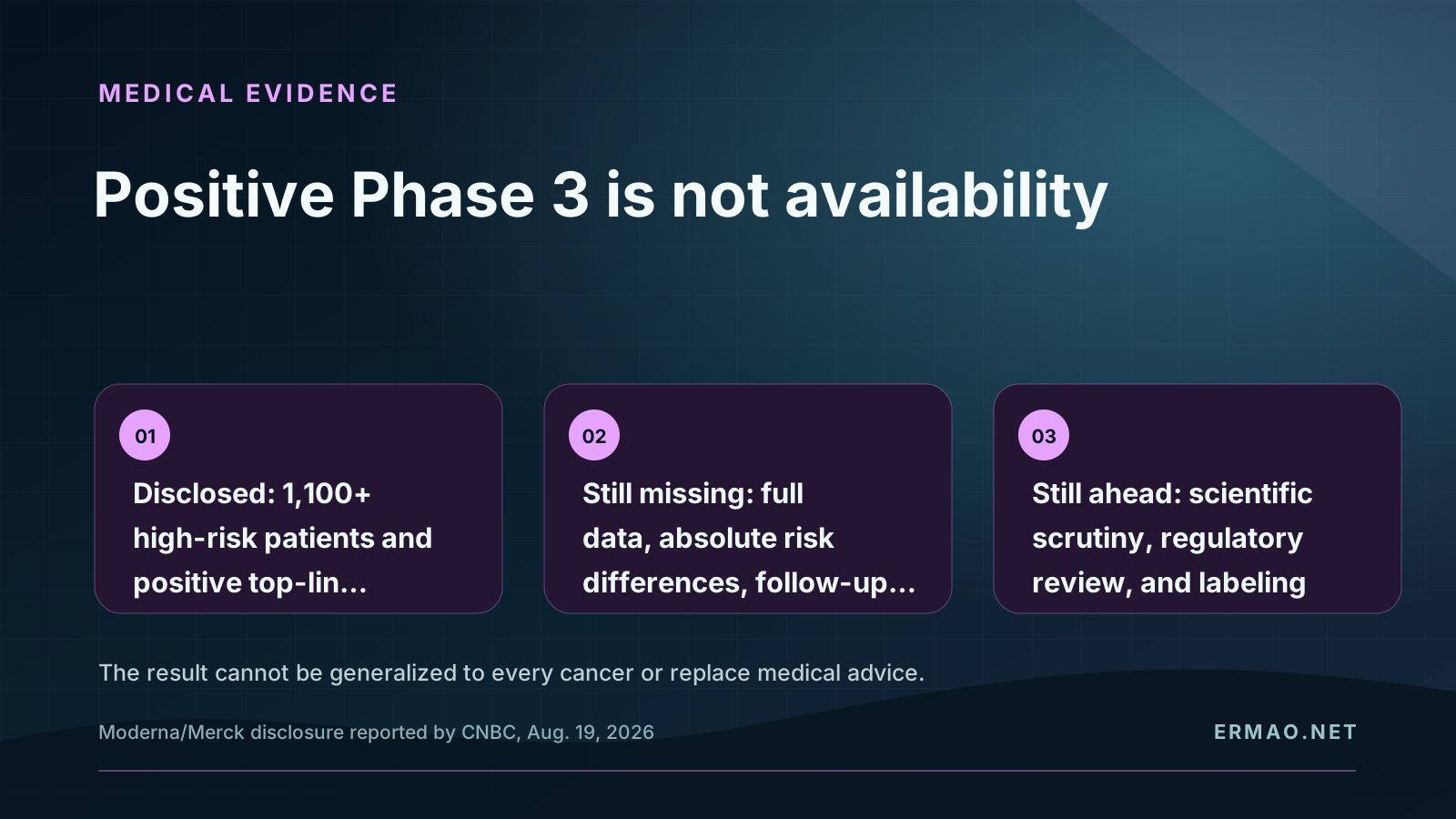
Before patient availability, the result still needs complete disclosure, scientific scrutiny, regulatory submission and review, labeling, manufacturing, and commercial preparation. Regulators may request more analysis or follow-up and may limit approval to a defined population. This digest does not provide individual medical advice and does not describe the product as approved.
The shareable lesson is an evidence ladder: mechanism, early trial, randomized late-stage trial, full data, regulatory decision, and real-world use are distinct stages. When a medical headline appears, asking about phase, comparator, endpoint, absolute effect, sample size, and approval status is more useful than memorizing a brand name.
A lighter moment
This week's lighter item is a counterintuitive engineering problem rather than a joke. A sensor usually becomes noisier as it becomes more sensitive. A Chinese research team published a model of noise and spin dynamics in anomalous Hall sensors and reported 15.7-nanotesla sensitivity at 1 hertz in a 20-micrometer-square artificial ferrimagnetic structure. The work does not upgrade every magnetic sensor overnight, but it suggests that changing spin dynamics can improve the trade-off instead of merely adding gain. The Physical Review Letters DOI is public; manufacturing scale, long-term stability, and biomedical performance remain unproven.
Practical actions
- AI API teams: Preserve OpenRouter's current routing and privacy policies, record the provider that actually handled each request, and verify ZDR eligibility, logs, keys, caches, and legal exceptions per endpoint.
- Apple alert recipients: Do not use links in the message. Verify through Settings or a manually entered official page, update the device, consider Lockdown Mode, and seek trusted specialist help.
- Camera administrators: Inventory models and firmware, replace default or reused passwords, disable unneeded P2P and cloud access, segment devices, and inspect unusual outbound traffic.
- v2rayN users: Update from the official release page, then review the provenance of old core downloads and reassess exposed credentials only where a questionable executable could reach them.
- Medical-news readers: Keep “positive Phase 3 endpoint,” “complete data,” “regulatory approval,” and “appropriate for me” separate.
Next checks and evergreen opportunity
Next week's priority evidence is whether Stripe and OpenRouter publish closing, ranking, or data-policy details; whether the Spirit data transaction receives court approval and conditions; whether Nokia issues a formal list of sites, staff, and support arrangements; and whether Dahua evidence can be mapped more precisely to models, firmware, and vendor remediation. OpenAI's September white paper should be compared with this week's architecture claims.
The evergreen follow-up is “A control map for AI services: routing, training data, Zero Data Retention, and safety signals.” It can place OpenRouter, bankruptcy data sales, and ZDR into one data-flow checklist: who processes content, how long it is stored, who owns the key, who can reconnect identities, and where enforcement signals originate.
Sources
- Stripe: Stripe agrees to acquire OpenRouter (Aug. 19, 2026; Aug. 20 in the Shanghai window)
- Axios: Stripe and OpenRouter transaction report (Aug. 19, 2026)
- U.S. bankruptcy court: Spirit Airlines de-identified data auction notice (Aug. 14, 2026)
- Axios: Google wins the Spirit Airlines data auction (Aug. 17 U.S. time; Aug. 18 in Shanghai)
- OpenAI: Offering Zero Data Retention for frontier models (Aug. 19, 2026)
- Apple: About Apple threat notifications and protecting against mercenary spyware
- TechCrunch: Apple's notification round covered 110 countries and regions (Aug. 14 in Shanghai)
- Hunt.io: Operation CameraSwarm (Aug. 18, 2026)
- The Hacker News: More than 14,500 Dahua devices compromised (Aug. 19, 2026)
- v2rayN 7.24.7 release notes (Aug. 15, 2026)
- South China Morning Post: Nokia reportedly plans to close most mainland China sites (Aug. 19, 2026)
- Lianhe Zaobao: Nokia reportedly scales back its China operations (Aug. 19, 2026)
- CNBC: Moderna and Merck report positive top-line melanoma Phase 3 results (Aug. 19, 2026)
- Physical Review Letters: low-noise anomalous Hall magnetic sensor research (August 2026)
Related reading
- Previous digest: fake VPN extensions, AI reasoning logs, and platform audits
- Windows and macOS internet-access guide
- Router-level routing, firmware, and failure boundaries
- Ermao Blog editorial policy · Submit a correction
Disclaimer: This is an information digest, not legal advice, investment advice, medical advice, a product endorsement, or a guarantee of service availability. Software versions, transaction status, attack scope, platform policies, and research evidence can change. A human editor must recheck sources, dates, numbers, images, and uncertainty before publication.