
Hainan's Planned SEA-H2X and ALC Cable Capacity—A Dated Comparison
The November 2025 Chinese source estimated that adding the planned SEA-H2X and ALC international submarine cables would give Hainan about 498 Tb/s of summed design capacity. Under its specific dataset and arithmetic, Hainan would rank behind Hong Kong and ahead of Shanghai.
This is a comparison of announced cable design capacity, not live throughput, owned capacity, completion status, or bandwidth available to an end user.
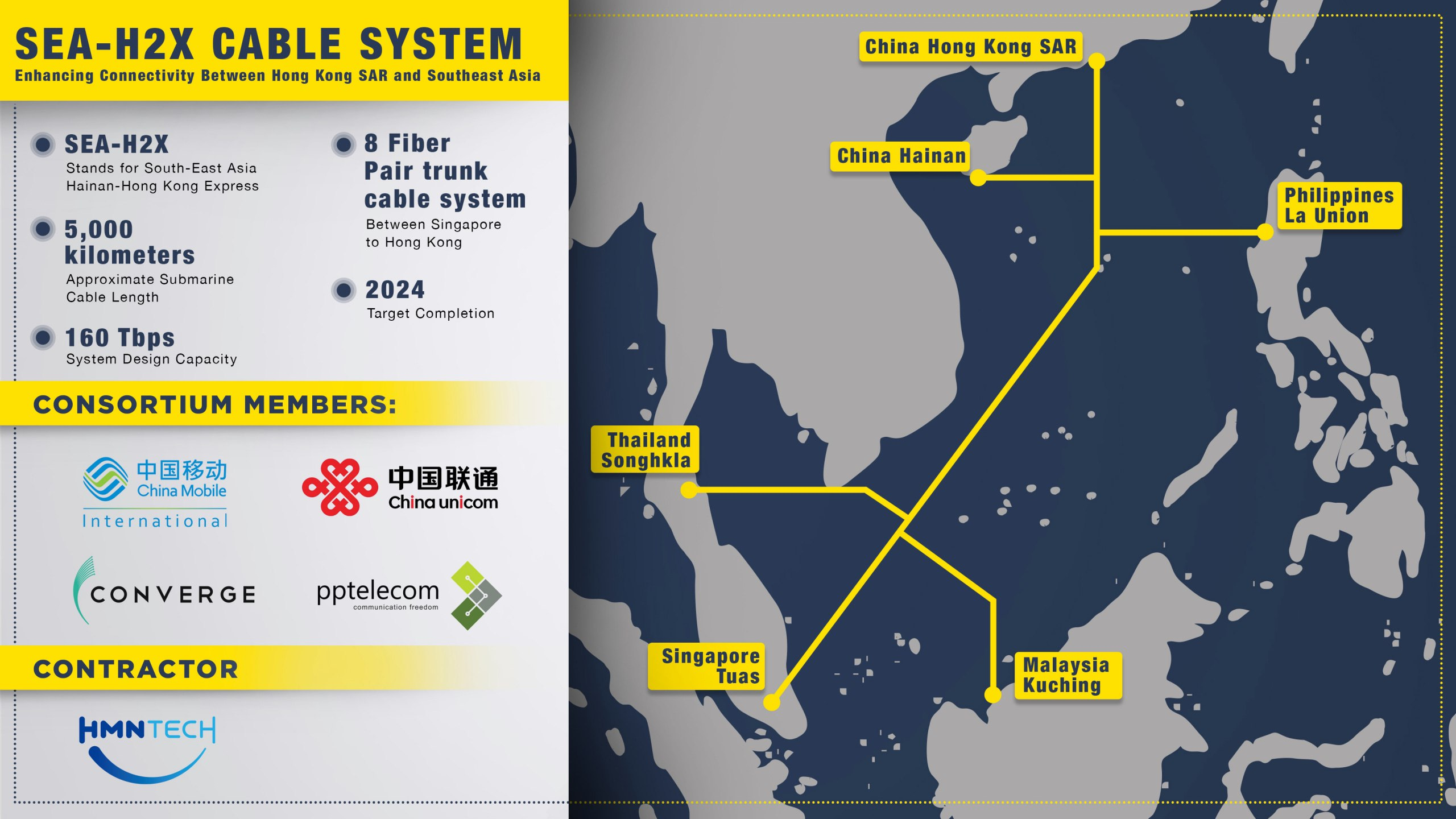
Short conclusion
If both planned systems land and enter service with the capacities used by the source, Hainan's dataset total moves from zero to approximately 498 Tb/s. The source calls this second among the listed Chinese landing regions, behind Hong Kong.
“Second” is conditional on:
- counting planned SEA-H2X and ALC capacity;
- treating Hong Kong in the same regional list;
- summing each landing system's design capacity;
- excluding terrestrial capacity and several other links;
- not allocating cable capacity among owners, fiber pairs, branches, or markets.
Three findings in the source
1. Conditional ranking
The source links:
It calculates:
- Hong Kong
- Hainan—498 Tb/s
- Shanghai—451 Tb/s
- Shantou—214 Tb/s
- Qingdao—56 Tb/s
2. Ownership qualification for Hong Kong
The source says that among international systems landing in mainland China, Hong Kong, or Macao over roughly 20 years, only three lacked a major Chinese state-owned carrier or subsidiary among the five largest investors.
It then performs a hypothetical exclusion of state-owned participation and calculates about 72.4 Tb/s for Hong Kong, or 6.7% of its original total. This is an analytical filter, not physical capacity disappearing. Investment participation also does not reveal each party's exact usable capacity.
The source notes that TGN-IA was a Tata system with 3.84 Tb/s in its dataset and cites a capacity arrangement involving PCCW.
3. Including the planned cables changes the table
All values below reproduce the source's simple summed design-capacity dataset in Tb/s:
| Region | Including the two planned cables | Excluding them |
|---|---|---|
| Hong Kong | 1,079 | 581 |
| Hainan | 498 | 0 |
| Shanghai | 451 | 451 |
| Shantou | 214 | 214 |
| Qingdao | 56 | 56 |
The source excludes a 307.2 Tb/s Hainan–Zhuhai–Hong Kong link, an 8 Tb/s Fujian–Taiwan link, and terrestrial cables because comparable public data was unavailable.
Method
The article:
- uses publicly reported design capacity for international submarine systems landing in a location;
- adds headline capacities without allocating ownership or usable fiber pairs;
- does not include terrestrial backhaul, metro bottlenecks, redundancy, utilization, commercial activation, or routing policy.
The result is closer to a theoretical headline-capacity comparison than an estimate of end-to-end throughput. A single cable branch's full system design capacity may also overstate capacity attributable to one landing point.
Why Hainan could matter
The source proposes several factors:
- approval of international Internet gateway functions for all three major carriers in Haikou;
- Hainan Free Trade Port and China–ASEAN connectivity policy;
- more direct physical paths toward Southeast and South Asia;
- additional route diversity for video, gaming, cloud communications, and enterprise connectivity;
- carrier interest in Singapore and ASEAN markets.
It also cites a media report about a “firewall removal pilot.” Public discussion or policy signals do not by themselves establish how filtering, licensing, or international routing will operate for ordinary users.
The Chinese source's phrase that capital can “recreate a second Hong Kong hub” is a forecast, not a measured outcome.
Potential impact
If the systems enter service and receive adequate backhaul and commercial capacity:
- platforms serving Southeast Asia could obtain more route options;
- cloud, CDN, SaaS, hybrid-cloud, and replication traffic could see new paths;
- latency and resilience might improve for selected origin-destination pairs;
- Hainan could attract landing-station, data-center, and interconnection investment.
Those benefits are not automatic. Actual performance depends on completion, lit capacity, fiber ownership, peering, terrestrial backhaul, congestion, policy, and commercial routing.
Conclusion
The source's 498 Tb/s figure describes announced design capacity under a simple methodology. It supports the conclusion that SEA-H2X and ALC could materially change Hainan's international-connectivity position. It does not establish current service, a finalized national ranking, or faster access for every user.
Related reading
Data scope
This page preserves a November 3, 2025 analysis. Check current cable ready-for-service dates, ownership, lit capacity, landing licenses, and route measurements before using it for investment or network planning.