
Updating Is Not Enough: Wallet Seeds, an npm Worm, Wan3.0, and China's Early Holiday Train Requests
This digest covers July 31 through August 6, 2026, in Asia/Shanghai time. The urgent lesson is that installing a fixed wallet app or firmware cannot make an old, predictably generated seed safe. Developers have a different immediate job: trace affected npm versions, workspace hooks, and exposed credentials. Wan3.0 is now testable on the web but not yet a generally available API, while a 12306 early reservation request is still not an issued train ticket.
What matters this week
| Lane | Event | Verified fact | Why it matters | Evidence status |
|---|---|---|---|---|
| Wallet security | Pre-4.0.0 CryptoJS weak randomness reached the seed-generation path of five named wallets | Researchers put the lower bound from two measured drain waves at $5.69 million; updating an app does not repair an old seed | Some users may need to move assets, not merely update software | 9/10; advisory, technical research, and reporting align, but complete wallet version ranges remain unpublished |
| Software supply chain | The Keyv-linked npm worm poisoned more than 400 packages | Research identified nine organizations and workspace hooks involving Claude Code and VS Code | Normal developer convenience features can become persistence points | 9/10; several security teams followed the incident, but execution and credential-loss totals are incomplete |
| Hardware wallets | Some old ColdCard firmware generated predictable seeds | Fixed firmware changes future generation, not existing key material | “Firmware updated” can create false reassurance | 9/10; vendor advisory and independent technical analysis support the mechanism, while loss totals remain partly unverified |
| AI tools | Alibaba's Wan3.0 video model entered a public web beta | The web product supports clips up to 30 seconds and lists per-second prices; general API access is still described as coming soon | Creators can test it, but developers should not plan production around an unavailable API | 8/10; access and posted pricing are checkable, while quality claims remain largely vendor claims |
| Digital services | 12306 opened the National Day early-request window for selected Beijing–Shanghai trains | Travelers may submit requests from day 60 through day 17 before departure; a request is not a ticket guarantee | The distinction changes how people should plan and monitor an important trip | 8/10; government guidance and same-day reporting support the flow, but no fulfilment rate is available |
| Science | Perseverance recorded an Earth–Phobos occultation sequence from Mars | Reporting says the July 2 sequence was made at roughly 314 million kilometers from Earth, which appeared about one pixel wide | The image turns planetary scale into something immediately understandable | 7/10; dated reporting and a NASA raw frame from the same sol are available, but the “first” wording still lacks a located NASA feature page |
Two predictable-randomness failures: why “updated” does not mean “safe”
CryptoJS: the dangerous question is where the old random function was used
The CryptoJS security advisory published August 5 addresses weak randomness before version 4.0.0. The underlying weakness is older than this reporting window. The material development this week was that Coinspect's technical disclosure and subsequent security reporting connected the path to five named wallet implementations: Randstorm, Browser Bitcoin Wallet, BIP39Standalone, Bexo, and Bitcoin Libre. Reports also mention Milo and RRWallet, but complete affected version ranges have not been published for every wallet.
It is tempting to reduce the event to “upgrade the dependency.” That can be sufficient when weak randomness generated a disposable visual effect and the vulnerable code will never run again. It is not sufficient when the output became the entropy behind a long-lived recovery phrase. The result is then preserved in the seed. An attacker does not need the victim to keep running the old application: narrowing the random space may permit offline enumeration of candidate seeds, followed by checks for funded addresses on public chains.
That is why exposure depends on the generation path, the generation date, and the exact software combination used at the time. The version shown on a device today is not the deciding fact. Conversely, a wallet name appearing in a report does not prove that every version and every user is vulnerable. A wallet absent from the current list is not automatically cleared either; the researchers say they cannot guarantee that every product which fed the weak function into seed generation has been found.
Researchers estimated a $5.69 million lower bound across two measured drain waves on EVM networks and Bitcoin. “Lower bound” matters. It is neither a complete audit of all affected wallets nor proof that every transfer linked by a secondary report came from the same exploit. The practical conclusion is strong even with that uncertainty: a seed created by a known affected path does not become unpredictable when the app is patched, and importing it into a new hardware device merely changes where the same key is stored.
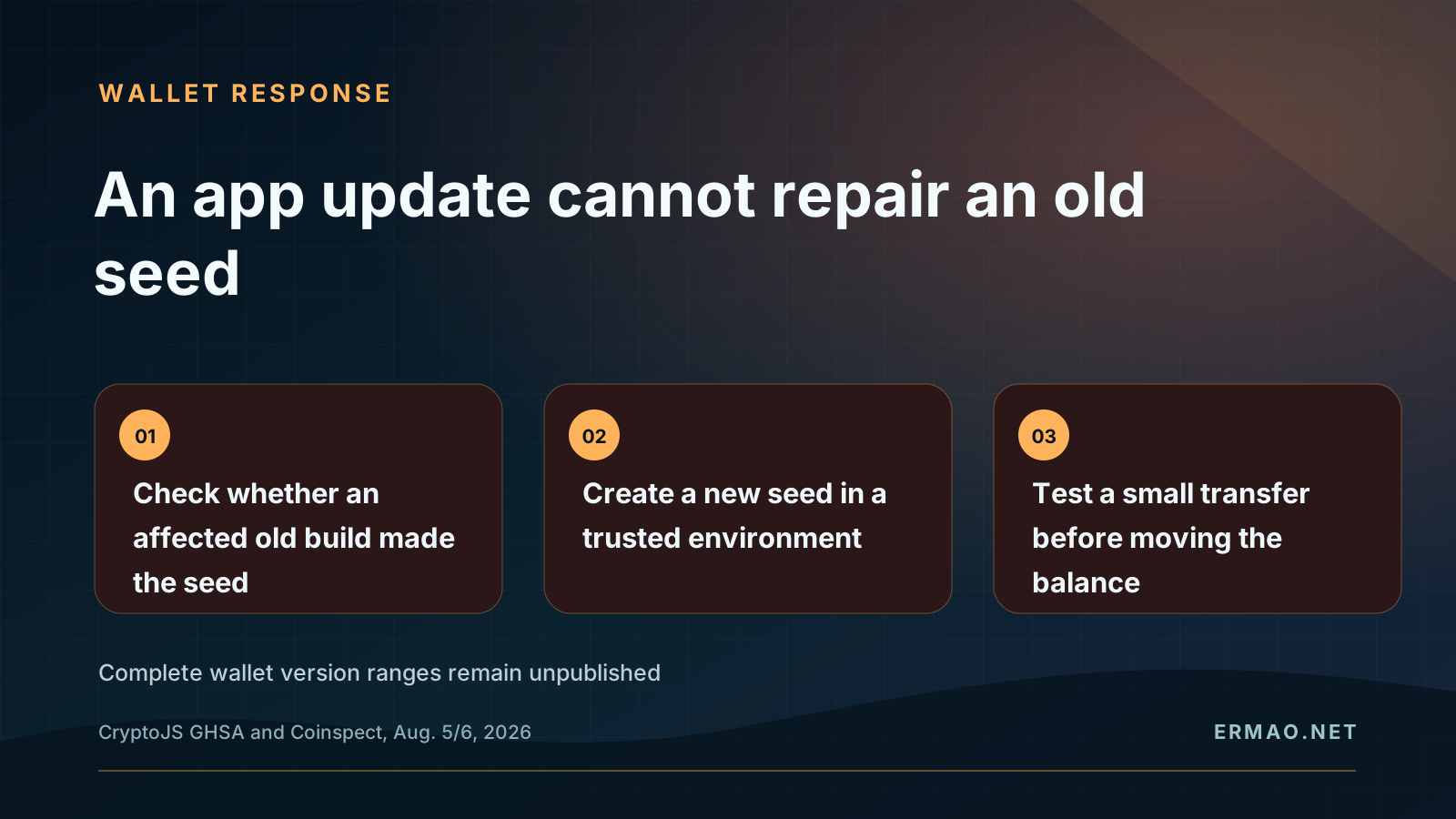
A cautious sequence starts by identifying which application and version generated the recovery phrase. If the known range applies, or the risky path cannot reasonably be excluded, create a brand-new seed in a trusted, clean environment using software or hardware obtained through a verifiable official channel. Verify the destination and signing flow with a small transfer before moving the remaining balance. Never type the old phrase into a search advertisement, an unsolicited support chat, or a third-party “migration” page.
This is not personalized asset-recovery advice. Multisignature setups, passphrases, address types, change addresses, inheritance arrangements, and wallet-specific procedures can materially alter the safe sequence. A large or complex holding can also be lost through a migration mistake. Ermao.net did not reproduce the vulnerability or test every named version, so project advisories and current vendor instructions remain the operational authority.
The durable follow-up opportunity is a wallet-seed migration checklist that never asks a reader to disclose a recovery phrase. It should distinguish creating new key material from changing storage hardware, include a small-transfer verification step, and explain how to watch old addresses and recurring deposits after the move.
ColdCard: firmware fixes future generation; migration addresses past generation
ColdCard produced a similar user consequence through a different mechanism, so it should not be merged into a claim that one JavaScript library compromised every wallet. Coinkite's updated security advisory describes a defect affecting seeds generated by some old firmware. Block's technical analysis explains why a predictable fallback and a 32-bit reseed did not provide the expected entropy. The archived scope includes Mk2/Mk3 firmware 4.0.1–4.1.9 and some older firmware for Mk4, Mk5, and Q, but readers should verify each model and build against the current vendor notice.
The relevant timeline begins when the seed was generated, not when the patch was installed. Corrected firmware can protect newly generated seeds from the known defect. It cannot add randomness retroactively to a phrase already written on paper, stamped into steel, or stored on the device. Backups and a new enclosure still represent the same old private keys. If the generation event falls inside the affected boundary, assets have to move to addresses controlled by new key material.
Bitcoin Optech Newsletter #416 provides additional technical context. Secondary coverage later cited estimates of 1,367 BTC, 4,585 addresses, and approximately $86.7 million to $89 million in losses; Solidot repeated the estimate on August 3. Those totals have not been fully and independently reconciled in the vendor advisory. They explain the high level of attention, but they should not be presented as a completed loss audit or proof that every listed address belongs to one attacker and one product.
The CryptoJS and ColdCard cases share a durable principle: when low entropy becomes a long-term private key, a software fix cuts off future generation but does not rewrite history. A strong passphrase, independently added dice entropy, or a multisignature arrangement may change an individual exposure, but only if it was actually combined correctly and supplied independent uncertainty. “I used a password” is not a substitute for checking the project's affected-generation criteria.
For a reader, the safest high-level order is to preserve the official instructions, verify the model and generation conditions from a trusted entry point, plan the move, test with a small amount, and then account for old addresses and future incoming payments. For a developer, the lesson is even plainer: an API returning bytes and using a reassuring cryptographic name does not establish suitability for durable keys. High-risk generation should call an operating-system cryptographic source explicitly and fail closed rather than silently fall back.
The npm worm: when developer convenience becomes a persistence path
On August 4, SafeDep reported that the Keyv-linked npm supply-chain incident had reached more than 400 packages across nine organizations. The Hacker News summarized follow-up findings from several security teams. Those figures describe packages and publishing organizations identified by researchers. They do not mean there were only 400 victims, that every download executed malicious code, or that every affected organization suffered a confirmed credential theft.
Many npm incidents are summarized as a malicious install script stealing a token. This one deserves more attention because researchers also found hooks involving Claude Code and VS Code workspaces. An attacker need not rely solely on a brief installation event if malicious behavior can be attached to the normal act of opening a repository, starting a development tool, or running a shared task. Workspace automation exists to make formatting, builds, and agent workflows repeatable. Once a package or repository publishing path is controlled, the same convenience can make hostile actions resemble project configuration.
Propagation and impact must be analyzed separately. A package in a dependency graph shows that code or metadata reached an environment. Execution depends on package-manager policy, lifecycle scripts, installation timing, and workspace behavior. Credential exposure then depends on which npm, GitHub, CI, cloud, or model-service tokens existed on that machine or runner. Turning “package count” into “infected-machine count” overstates the evidence and encourages teams outside the headline list to stop looking too early.
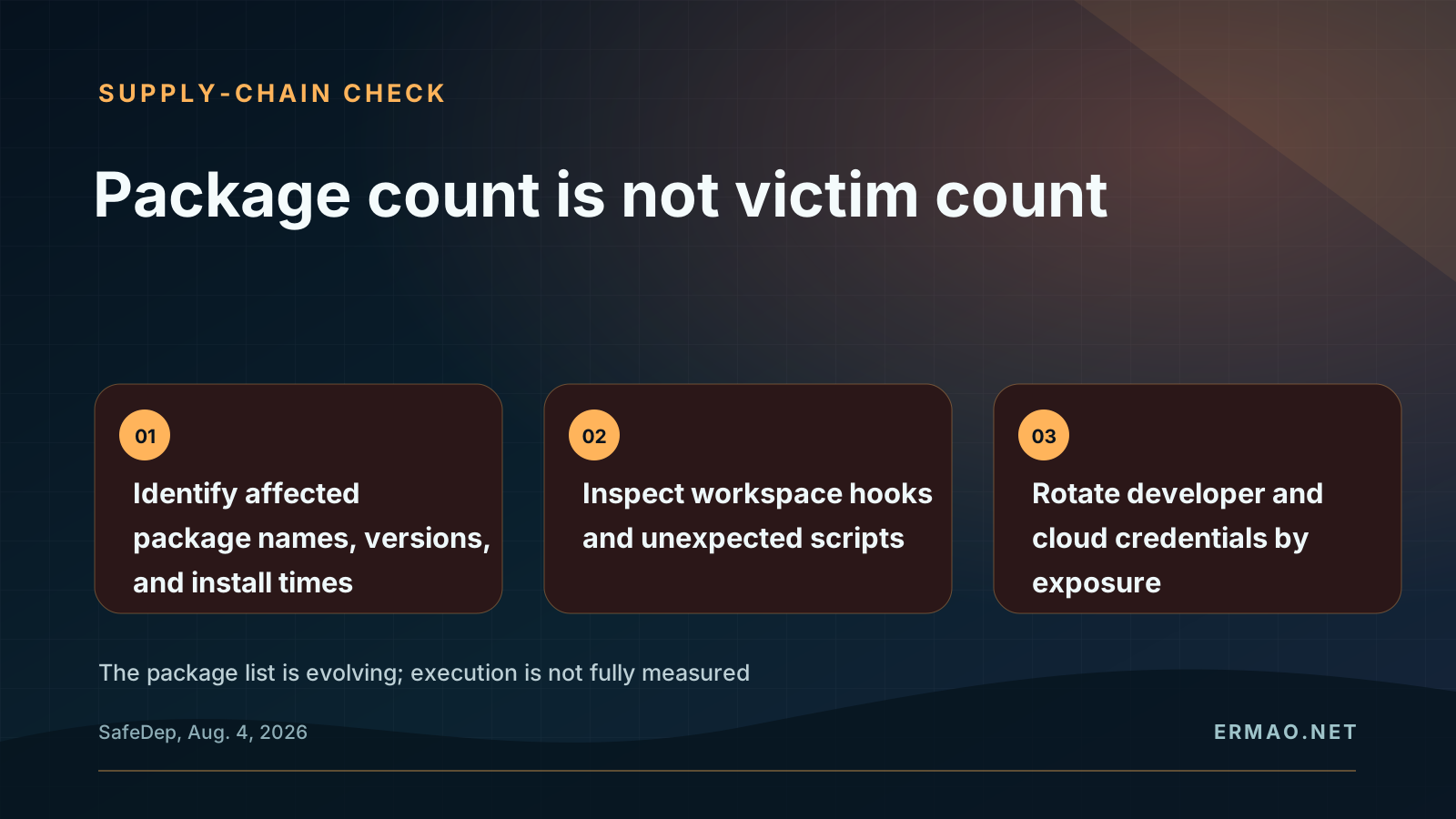
The smallest useful investigation is chronological. Start with the researchers' current package and version list. Locate those versions in lockfiles, build caches, images, and CI logs, then establish when installation could have occurred. Inspect unexpected workspace settings, hooks, tasks, and scripts added around that window. Rotate npm publishing, source-control, cloud, and development credentials according to actual exposure. A blanket rotation without tracing the execution path can miss the initial persistence point and cause avoidable production outages.
Recovery is not just npm update. Removing or upgrading a malicious version can prevent later installation, but it cannot revoke a stolen token, undo a hostile package release, or cleanse a modified repository configuration. Teams also need organization audit logs, anomalous publishing activity, unknown sessions, and cloud-resource changes. Artifacts built during the exposure window may require their own provenance check. When evidence is incomplete, the honest status is “no evidence found yet,” not “confirmed unaffected.”
The AI-tool angle does not require a new security platform. Project-level configuration that an agent or editor can execute belongs inside the same review and trust boundary as source code. Before opening an unfamiliar repository, disable automatic tasks where practical, read workspace configuration, and avoid leaving broad, long-lived credentials in the environment. A future evergreen “30-minute npm incident check” could cover lockfiles, installation windows, workspace hooks, token rotation, and downstream artifacts without pretending to replace a full forensic investigation.
What Wan3.0 actually opened: a usable web beta, not yet a general API
On August 6, Alibaba Cloud's Wan3.0 model page began exposing public-beta access, while same-day reporting documented the available web entry points and pricing. The checkable change is that users can submit web jobs for clips up to 30 seconds and provide text, documents, spreadsheets, presentations, or web pages as inputs. Posted prices are RMB 0.3, 0.6, and 1.2 per second for 480p, 720p, and 1080p output respectively.
Three availability stages should not be collapsed. A product can have a public description, it can accept jobs from ordinary users on the web, and it can expose a documented, stable API for production integration. This week Wan3.0 crossed the second threshold. The model page still describes broad API availability as coming soon. Creators can therefore test samples now; engineering teams should not promise a production workflow based on an interface, quota, or service boundary that has not yet been generally opened.
Per-second prices also need task context. At the posted rates, a 30-second result is arithmetically RMB 9 at 480p, RMB 18 at 720p, or RMB 36 at 1080p. That is not a project budget. It excludes failed generations, prompt iterations, input preparation, promotional credits, and future pricing changes. The meaningful cost is how many attempts produce one usable clip, not merely the price of one ideal run.
Alibaba and coverage describe character consistency, realism, long takes, and document-to-video capabilities. Ermao.net did not independently test those claims or run a controlled comparison using identical source material. A working public beta proves a change in access, not every quality claim. A sensible evaluation uses a fixed, non-sensitive input and records resolution, duration, queue time, failures, usable-output rate, and total spend before choosing whether the system fits brainstorming, explanatory demos, or client delivery.
Document and webpage inputs add a data-handling question. Contracts, internal spreadsheets, unpublished decks, and client assets should not be uploaded merely because the interface accepts the format. Teams should review current privacy, retention, and training terms and begin with de-identified samples. Format support does not guarantee that formulas, complex layouts, animation, hidden slides, or embedded objects will be interpreted as intended. Final outputs still require checks for likeness rights, trademarks, source licenses, and factual claims.
The concise reader conclusion is: web access is a present fact, API access remains a future availability statement, and quality still requires task-specific testing. Our Cloudflare Wallet explainer examines another emerging digital-service boundary—AI agents and programmable payments. It is a different product, but the same distinction between a demonstration, account-level availability, and a production dependency applies.
China's 12306 early train request: submission, fulfilment, and ticketing are different states
A Beijing government notice published July 17 explains a 12306 pilot for selected Beijing–Shanghai high-speed and conventional trains. The National Day travel window reached its corresponding request date on August 2, prompting same-day coverage. The pilot covers more than 200 trains. Travelers can submit requests in the 12306 app from day 60 through day 17 before departure; August 2 corresponded to September 30, and August 3 to October 1.
“Available for reservation” is easily rewritten as “tickets go on sale 60 days early,” but the mechanisms are different. The early phase records a requested train, seat class, and journey. The system later tries to fulfil it against capacity and ticket allocation. Only a fulfilled order that completes the required payment becomes a purchased ticket. Ordinary sales and waitlisting retain their own timelines. A screenshot confirming request submission should not be cropped and represented as proof of issuance.
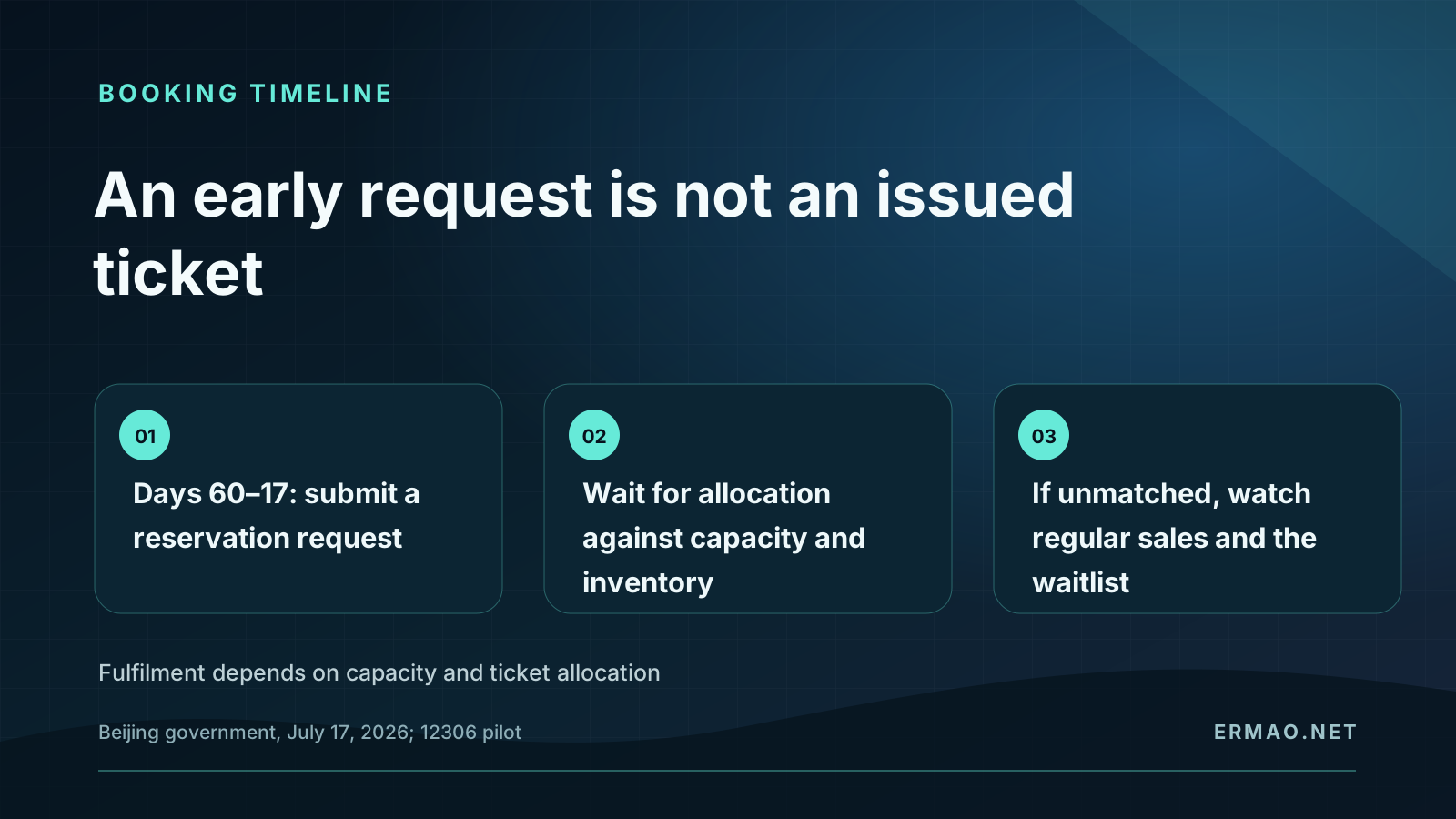
The pilot can still be useful. Families, students, and business travelers can express a firm need earlier, and the railway may gain earlier demand signals. It does not create unlimited seats. Fulfilment depends on capacity, allocation, and competing requests. The current sources do not provide a final fulfilment rate for the National Day window, so the pilot must not be sold as a guarantee or as the end of high-demand ticket competition.
A practical plan is to preserve the request conditions and notification schedule, verify passenger identity, travel date, train, class, payment, and cancellation deadlines, and separately calendar regular sales and waitlisting. A text message or link should be verified by returning to the official 12306 app rather than re-entering identity or payment information on an unfamiliar page. A fixed trip also needs fallback times, stations, or transport instead of waiting until the last moment to learn whether the request was matched.
This is a useful example of why digital services need explicit state labels. Submitted, pending fulfilment, awaiting payment, and ticket issued have different consequences for money and travel. A precise timeline is more valuable than the phrase “book 60 days early.” A durable comparison of early requests, waitlisting, ordinary sales, and refund rules could be useful later, but only after the official rules are stable enough to verify line by line.
Weekly interest radar
From Mars, Earth was about one pixel wide
An August 6 report, citing NASA, says Perseverance recorded a sequence on July 2 in which Phobos completely occulted Earth. The Earth–Mars distance was reported as approximately 314 million kilometers, and Earth appeared roughly one pixel wide. A NASA Perseverance raw-image page for sol 1907 verifies a July 2 frame and NASA/JPL-Caltech credit. This run did not locate a NASA feature page that simultaneously explains the full sequence, image processing, and the report's “first” wording.
The geometry does not mean Phobos traveled in front of Earth in physical space. Perseverance was observing from Mars, and nearby Phobos crossed the rover's line of sight to the extremely distant and tiny point of Earth. A small nearby object can cover a much larger distant one in angular size, just as our Moon can occult a distant star from an observer on Earth.
The sequence is valuable not because it establishes a new law of physics, but because it compresses scale into an intuitive picture. Our entire familiar planet becomes one pixel from hundreds of millions of kilometers away, while a much smaller Martian moon can cover it because the moon is close to the camera. It is also a lesson in image evidence: a compelling sequence may involve alignment, cropping, enhancement, or chronological arrangement, so the reader should look for raw frames, acquisition times, instrument details, and processing notes.
The evidence boundary remains important. The “first recording” language and full processing details were not directly confirmed on a located NASA feature page. This draft therefore attributes that part to reporting that cites NASA, rather than turning it into a formal mission-team milestone. The archived republished image is review-only and is not used here. If a NASA/JPL asset page is located during human review, it should replace the secondary reference after its exact credit and reuse terms are checked.
A lighter moment
AI can find vulnerabilities—and generate a queue of things that merely resemble them
Apple's current Security Research terms allow action against sustained, high-volume submission of spam, false, or AI-assisted reports that have not been human-validated. August 2 coverage also says concurrent submissions can be limited, with a path to request more capacity for critical reports. The week's understated irony is that AI lowered the cost of producing a plausible-looking finding without lowering the maintainer's cost of reproducing, triaging, and validating it.
This is not “Apple banned AI vulnerability research.” The confirmed boundary concerns spammy, false, and unvalidated high-volume submissions. Default quotas, total backlog size, and a reported third party's full set of vulnerabilities are not publicly itemized here. The scarce resource remains unglamorous: reproducible steps, a minimal sample, affected versions, a threat model, and human confirmation. A model output can be a lead; it is not a license to outsource verification to the maintainer.
Practical actions
- Wallet users: Check current project advisories if an old phrase may have been generated by affected software or firmware. Create new key material in a trusted environment and test a small move before migrating the balance. Never disclose the phrase to a “support” contact or migration website.
- JavaScript teams: Match affected npm names and versions against lockfiles and installation windows, inspect workspace hooks and CI logs, then rotate publishing, source-control, and cloud credentials according to actual exposure.
- AI video users: Evaluate with a fixed non-sensitive sample and record failure rate, retries, final cost, and usable-output ratio. Do not describe a web beta as a stable integration before the API exists.
- National Day travelers on Beijing–Shanghai routes: Separate request submission, fulfilment, payment, and issuance. Watch ordinary sales and waitlisting as well, and do not pay through unfamiliar message links.
- Editors and people sharing these stories: Preserve the source level for loss totals, package counts, model quality, and “first-ever” imagery. A research estimate, vendor claim, and official statistic are not interchangeable.
Next checks and evergreen opportunity
Next week should prioritize complete wallet and firmware version ranges, independent reconciliation of losses, and clearer official migration instructions for both CryptoJS-linked wallets and ColdCard. The Keyv-linked package list should be checked for stabilization and for evidence of execution, credential use, or contaminated downstream artifacts. Wan3.0 reaches another material milestone only when its API, documentation, and quotas actually become available. The 12306 pilot needs official fulfilment rules or aggregate results rather than anecdotes from social media.
The named evergreen follow-up is an old-seed migration and anti-phishing checklist. It should separate updating software, generating a new seed, verifying destination addresses, moving funds in stages, and monitoring old addresses and recurring deposits. It should also distinguish app wallets, hardware wallets, multisignature arrangements, and additional passphrases. It is worth publishing only after procedures from affected projects can be checked side by side; it must never ask readers to submit recovery phrases to this site or any third party.
No proxy-tool release was forced into this edition. The mandatory second look re-compared sing-box 1.14.0-beta.7's Hysteria2 Chrome QUIC handshake mimicry and certificate-compatibility boundary. It scored 8, but remains a beta capability with less immediate and broad consequence than the selected events. That absence reflects the evidence and reader-value threshold, not a change in Ermao.net's interests. For the previous window's cross-border infrastructure and AI-service incidents, see the July 24–30 weekly digest. Readers building a private assistant can also consult the OpenClaw beginner guide, while treating third-party code and workspace configuration as supply-chain inputs.
Sources
- CryptoJS: GHSA-rg76-677x-56q9, August 5, 2026.
- Coinspect / Ill Bloom: CryptoJS weak-randomness technical disclosure, accessed in this run; no clear page date displayed.
- The Hacker News: CryptoJS Weak RNG Behind $5.7 Million in Drains, August 6, 2026.
- Coinkite: Coldcard Security Advisory, updated August 1 U.S. time / August 2 Shanghai time.
- Block: Predictable RNG Fallback and 32-bit Reseed, July 30, 2026.
- Bitcoin Optech Newsletter #416, July 31, 2026.
- Solidot: secondary report on ColdCard loss estimates, August 3, 2026.
- SafeDep: npm Worm Poisons 400+ Packages Across Nine Organisations, August 4, 2026.
- The Hacker News: Keyv-Linked npm Worm Poisons Hundreds of Packages, August 4, 2026.
- Alibaba Cloud Bailian: Wan3.0 model page, accessed August 6, 2026.
- ITHome: Wan3.0 enters public beta, August 6, 2026.
- Beijing government: 12306 60-day advance request pilot, July 17, 2026.
- ITHome: 12306 begins accepting National Day travel requests, August 2, 2026.
- ITHome: Perseverance records Earth occultation, August 6, 2026.
- NASA Mars: Perseverance sol 1907 raw image, acquired July 2, 2026.
- Apple Security Research: Terms and Conditions, accessed August 2, 2026.
- ITHome: Apple limits high-volume vulnerability submissions, August 2, 2026.
Related reading
- What Cloudflare Wallet is: AI agents, x402, and programmable payments
- OpenClaw beginner guide: build a private Telegram AI assistant
- Cross-Border Network and AI Weekly, July 24–30, 2026
- Ermao.net editorial policy
Disclaimer: This is a public-information digest, not legal advice, investment advice, a product endorsement, exploit guidance, or a guarantee of service availability. Wallet migration, credential rotation, ticketing, and beta access can change by version, account, region, and later notice. Recheck the relevant official source before acting.